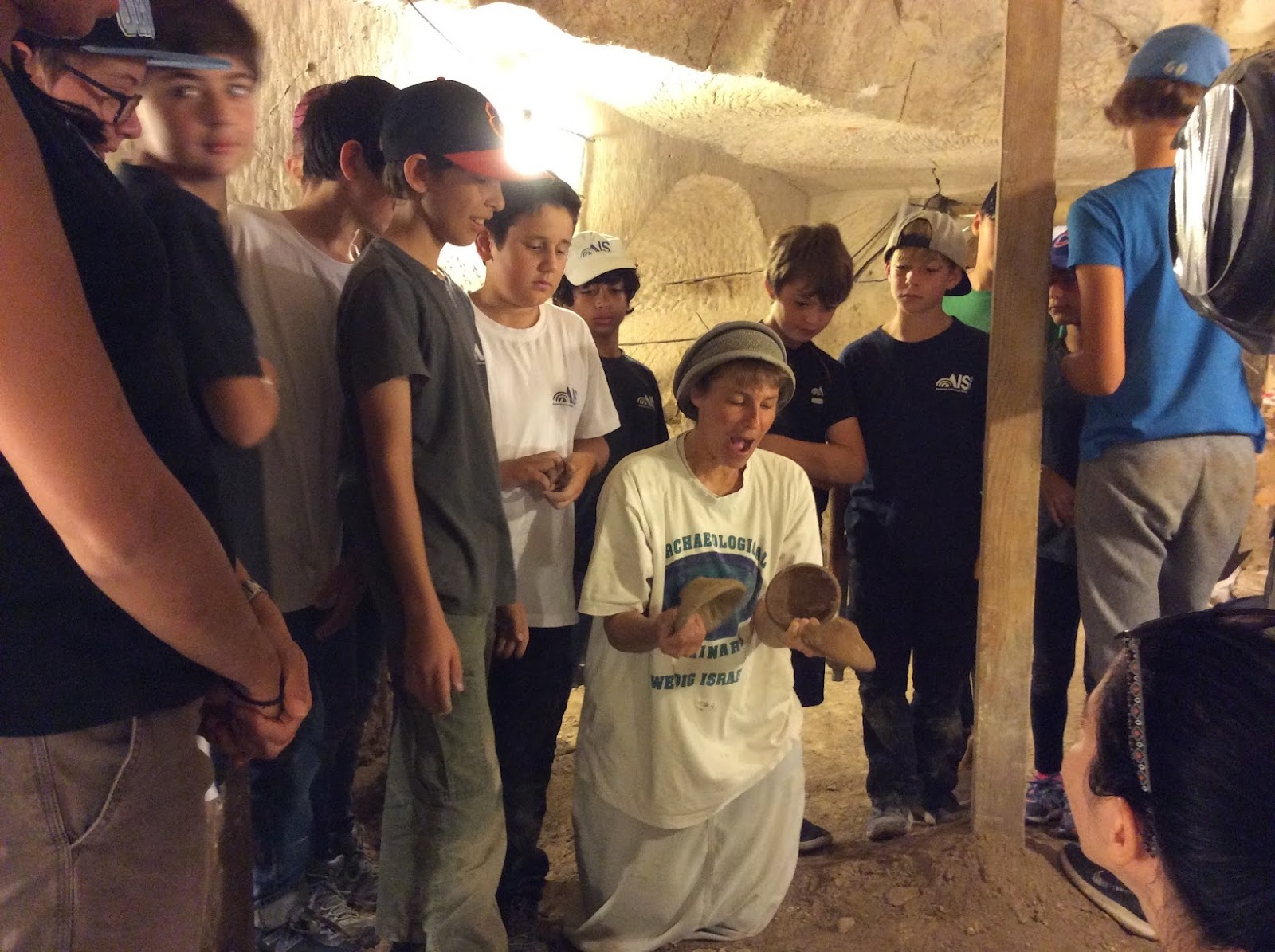
At the end of October, 6th graders visited Beit Guvrin, a National Park in the south of Israel that encompasses Moresha, one of the important towns of ancient Israel known in Biblical times.
Students didn’t mind to make their hands dirty while digging two ancient caves of the past. This time, in the layers of the past, they found unique artifacts that surprised even professional archaeologists!
To understand the significance of hands-on experiences and the importance of excavated remains, students learned about archaeology before the field trip in their Humanities class with Mr. Goury and Ms. Brodsky. They examined how science helped understand human history and got an idea about how to see the culture through the material objects.
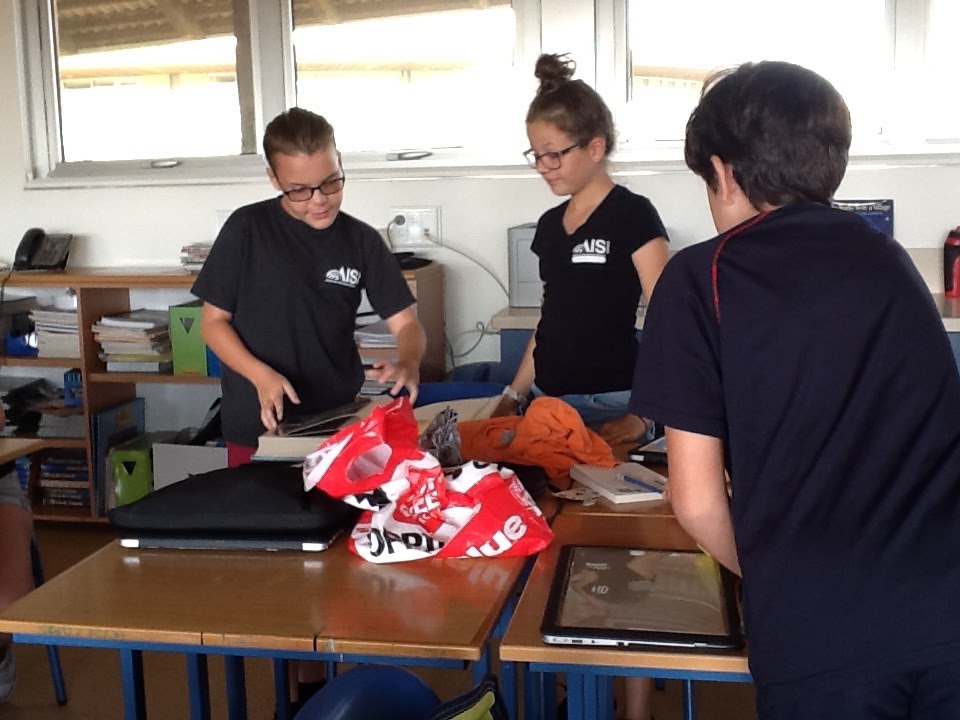
In groups, students composed “trash bags”. They collected everyday objects that would help archaeologists of the future discern the life of nowadays. Students described the items as if they were the archaeologists, presented them in class, and brainstormed about what could be learned about the 21st century from these artifacts.
The engaging activity made students think of their responsibilities for the future, the importance of taking care and preserving the environment and leaving positive footprints. Students practiced other essential skills. The work on the mini project encouraged kids to be insightful strategic researchers and effective collaborators. Being an effective communicator, able to listen and understand, take turns and respect others are crucial in a profile of every individual.
An expression a "serious fun" describes a "learning environment where students are engaged, academics are rigorous and learning is clearly evident" (Hirst-Loucks and Loucks).
Activities offered during Library Tech Week were not only fun but integrated STEM subjects, promoted creativity, problem-solving, collaboration, project and idea exchange, and advocated the connection of academic learning with real life. Students did have "serious fun" during the week! Integration of STEM
Two WBAIS critical values, STEM and recycling, were supported with various activities.
An inclusion of artistic and creativity into science, technology, and engineering evolved STEM into STEAM. We admire imagination and arts!
Maker space.
Kids used their artistry and played with paper rolls, buttons, broken computer parts, disposable plastic cups and plates and other recyclable materials.
Everyone was curious about 3D printers. They could watch for hours how the Chuck Hull's invention was building up white and red castles, robots, deer, star wars spaceships and other objects.
Collaboration
Students from different grade levels collaborated and participated in a project exchange by demonstrating their work and learning to peers.
High School students shared their skills with Middle and Elementary students while Middle School students presented their projects to the grade school.
Assembling electric circuits, building molecular models, learning chess moves, and writing star related poems engaged students of all ages.
Students' Leadership
Jonathan and Kanishka ran a Star Wars booth. Younger kids were thrilled to see their photographs been Photoshopped into Star War characters.
Maria and Riti made a presentation about the evolution of their computer skills at Computer App class, and Matan demonstrated how playing DuoLingua could improve one's knowledge of a foreign language.
Teachers' involvement
Teachers generously offered their subject expertise. Their passion and enthusiasm were contagious. Students experimented with wires, lamp bulbs, batteries, fans, and bells.
Ms. Salem, English Language teacher, inspired her students to create bookmarks with Shakespearean quotes.
Language Diversity Booth Modern Language teachers initiated celebration of WBAIS lingual and cultural diversity.
The theme of the booth "In the galaxy of languages, every word is a star" motivated writing poems, proverbs and sayings, and just words related to stars in many languages.
Sra. Vahab and Sra. Cohen made two pinatas in a star shape to be broken the last day of our special week. What a great cultural introduction!
Career orientation
Activities and an exposure to latest technologies introduced children and adults to new trends in real life. Guest speakers and student-presenters spoke about 3D printing, apps, robotics and applied sciences.
Mr. Librus brought many 3D objects and spoke about the use of 3D printing in research, medicine, industry and commerce.
The WeDiggit team explained what green-screen technology is and how it is used in media production. Students practiced composing a green-screen video stream.
Library Tech Week has brought the entire WBAIS community together.
Check out a Media Production Class message about the week:
Integration of STEAM, Makerspace, student collaboration and leadership, teachers' enthusiasm, and guest speakers' presentations made LTW of 2016 a "serious fun".
Thank you, everyone, for supporting our annual event!
Preparing to their work on background information for Science Fair projects Middle School students review how to find, evaluate, organize and cite facts and data. As the result of their learning, students have created short presentations that will help them and their classmates remember the strategies learned and practiced in class.
Discussions is a powerful way to develop academic language, thinking and social skills. Students enjoy class discussions because they learn from hearing other people's opinions, comment and connect what is being said to what they learned in class, draw conclusions about the subject matter. They are actively involved into conversations and learn to show their interest through taking notes, eye contact, smiling, nodding, and body language. Students pose questions, summarize and explain their own ideas and points of view.
Students dig deep to understand complex informational texts and sum them up precisely.
This year, our goal is to help students perceive meaning of scientific texts kids read on the subject matter and be able to summarize complicated texts to demonstrate their understanding when they look for background information to back their lab results and Science Fair projects.
Students analyze texts and pay close attention to details they would otherwise skip if not having proper support from their science teacher and information literacy specialist.
Through collaboration, Mr. Ratner and Ms. Bee apply the close reading strategy to implicitly broaden kids' background, improve their understanding and raise their curiosity.
Among learning approaches used in class are brainstorming, identifying and using new vocabulary, small groups discussions, writing summaries and creating proper citations. Students acquire and practice necessary skills to effectively achieve positive results in their future research works and Science Fair projects that are coming SOON!
A team of collaborators - English Language teacher, her assistant, and Media and Information Literacy specialist - once again has proved that collaboration is a powerful strategy to deepen student learning and reach an effective understanding of academic material. Ms. Salem, Ms. Cannon and Ms. Bee support 9 Grade students in their research skills acquisition on iSearch project.
Students create essential questions, identify primary and
secondary sources to find evidence in reliable sources, conduct
interviews, provide proper citations and organize information into a
research paper.
In groups, students reflect what skills they have learned, practiced and mastered, and discuss how these skills are necessary not only for their academic success but for being effective in day-to-day operations.
[Ms. Cannon and Ms. Bee demonstrate what personal interviews should NOT be]
[Ms. Salem and Ms. Bee address students' questions about their First Drafts]
In class, students work on a research project. They use information from multiple sources, take notes and cite materials following the MLA format. They turn their projects to the teacher... and the teacher is disappointed. Research papers look like encyclopedia articles or book reports.
What is the problem?
Suggestions:
Before the project is long underway, students examine several research papers. Their attention is drawn to the details that make research papers not a mere review of information found on a topic. A research paper is the result of an intense work and interaction with primary and secondary sources followed by an evaluation of these materials. A research paper is a composition in which students express their personal ideas and points of view and support them by information found in reliable sources.
In addition to presenting a summary of arguments of other authors on the topic (Report), students analyze, examine, discover and revise facts, theories and applications (Research) through a series of steps (Research Process) in order to develop their own ideas and express them in a form of a product.
You may decide to "apply" knowledge and focus on creating a product. Then, your learning will grow along making and presenting it to the audience.
Keywords:
Primary Sources - are information "collected directly from the real world". They include interviews, surveys, observations, analysis and ethnographic research (Purdue OWL).
Secondary Sources as opposed to primary sources are articles, books or websites that interpret primary sources. These sources are "works of synthesis and interpretation based upon primary sources and the work of other authors" (Teachinghistory.org).
Research – is a diligent and systematic inquiry or investigation into a subject in order to discover or revise facts, theories, applications, etc. Synonyms: investigation, analysis, fact-finding, examination, scrutiny (Webster).
Report - isa review of what others have written about a topic, given a spoken or written account of something that one has observed, heard, done, or investigated, presenting a summary of arguments of other authors on the topic. Synonyms: describe, communicate, publish, publicize.
Project - is an individual or collaborative enterprise that is carefully planned to achieve a particular aim (Oxford Dictionaries Online)
Research paper reviews the materials written about a topic, draws one’s own conclusions and argues his/her point.
Research Process – is a series of steps, which make up research from the development of an idea to the completed research paper.
Paraphrasing, summarising and quoting are the three ways of presenting someone's ideas and phrases that Middle School students are often struggle with. To help students grasp the difference, Humanities teacher Mr. Sullivan and I, library media specialist conduct a purpose-built class activity.
Before we start a lesson on paraphrasing, summarising and quoting, six grade students are divided by groups. They brainstorm and share their understanding in front of the class. Other students listen carefully, take notes and ask questions when the presentation is over.
Building an even clarer differentiation between the tools through a dialogue is the next step of student discovery. Students are paired to develop each concept through a conversation. We guide student discussions by asking open questions.
Below are the results of the class discussions.
Quoting: What? Quoting is an exact reproduction of spoken or written words. It's usually a short message that
supports and not replaces students' own ideas. Why? Writers use quoting when the exact wording is the best way to convey a message. How? The message should not be altered. Quotation marks are used in the beginning and at the end of the message.
Paraphrasing: What? Paraphrasing is a way to express the original ideas in ones own way by using different words. Why? It is done to support students' original ideas and/or provide evidence.
How? Paraphrasing doesn't make the original text shorter.
A correct way to paraphrase is
to read the original text carefully and understand it.
Then, identify key words and main ideas and relationships between them as well as the author's attitude toward information you are paraphrasing.
When paraphrasing, change the grammar and sentence structure but keywords, main ideas and relationships between them keep the same.
Express the attitude the author has to treat the original text, that is confidence, doubt, criticism, or other.
Summarising What? Summarising is a way to convey main ideas of the original text. Why? Summarising is used to support main ideas of student writing or provide evidence to prove student thoughts. How?
To summarise, read the text, take notes and outline the main ideas.
Leave out details and examples.
Close the text and rewrite notes in your own words.
High School students were assigned to perform a research on topics covered in Statistics. The goal of this post was to guide students through the research process and help them find appropriate sources.
Research Process
Step 1: Identify a problem
First, identify the topic you want to research on and how it is connected to Statistics.
For example, you could think, "Animals were always a topic of my interest. My wish to work with animals in the future has determined my research project on statistics. How can I connect animals and statistics? How are these two subjects connected?"
Step 2: What do I know?
I know that scientists build plans on preventing endangered animals from extinction, people count species, they use animals for scientific experiments. Scientists work with animals in Zoo parks.
Step 3: What do I want to know?
I want to recognize how statistics is applied to the world of beasts.
Step 4: What resources I can use to learn more on the topic?
Library resources
books
databases
Science Online (Facts on File)
EBSCO (journal articles, scholarly and peer-previewed)
JSTOR (academic articles from professional journals)
Websites
Google Advanced search
Google Scholar and Google Legal
Step 5: How shall I find the resources (Strategies/Skills I will use)?
Library catalog
Use the library catalog to find resources on your topic.
Open the library catalog, choose Power search and use keywords: animals AND statistics
Browsing through the articles' abstracts allowed you to learn more about the use of statistics in the animal world. You've learned that statistics is applied to discover geographic distribution of species and its meaning (JC Willis, GU Yule - Nature, 1922 - blog.sciencenet.cn), the statistics of natural selection (BFJ Manly - 1985 - cabdirect.org), Make a question. For example,
How can animal abuse be prevented by statisticians?
What is the minimal number of animals that scientists need for an experiment?
Can the number of animals living in a particular area in 10, 20, 30 years be predicted?
Step 7: Research question
Suppose, you want to answer the first question, How can animal abuse be prevented by statisticians?
Step 8: Keywords for the research question (query)
[animal abuse prevent statistician]
site:gov
Office for the Prevention of Domestic Violence - http://opdv.ny.gov/whatisdv/dvanimalcrlty.html
Ctrl-F - statistics
Step 9: Analyze search results and what you've learned
Protecting more than animals
http://search.ebscohost.com/login.aspx?direct=true&db=hxh&AN=19103753&site=src-live
This article focuses on alternatives for testing chemical toxicity on animals that uses fewer animals. Safety testing of household, agricultural and other chemicals as well as medical products traditionally uses many millions of animals every year in protocols that are often painful. New methods, involving cell and tissue cultures, noninvasive imaging, or plain statistics are greatly reducing the need for, and the suffering involved in, animal testing. The new toxicology is more rigorously based on scientific evidence and can save time and money. Step 10: Statistics applied to the collected data.
Apply your knowledge to treat the collected data as a statistician.
I've just read Doug's posting in his Blue Skunk blog and was very much encouraged not by the long list of publications and demonstrations presented by him in 2010 but by him saying, "I "shipped" - you can too". Indeed, we can share our "shippings" with others and by doing this enspire our colleagues to evaluate their productivity of the past year and project future achievements.
My "shipping" list is much shorter but anyways I want to make one to see where I am at the beginning of 2011:
In 2010, I've got a new title. Now I am Librarian/Technology Integrator and Periodicals and AV Equipment Assistant.
Our e-book collection has grown, and I am learning how reading books in digital format effects students' interest in reading.
I am working on integration of Information Literacy skills into core curriculum. Two collaborative projects, High School course on Information Literacy and Middle School Elective "Web Cafe"can be put into the basket.
Let the number of start-up projects be listed here as well:
Preparation for a presentation at NESA Spring Conference in Bangkok, April 2011
Organization of NESA librarians' gathering and round table presentations at ECIS in May 2011
Development of a Middle School course "Books Digitally" where students will read books on Kindles, iPads, and their PCs and create digital projects about them.
Many digital tools are added to the MBtoolbox collection, and a few articles are written for the school newsletters and NESA News.
Thank you, Doug, for showing us what fun it is to summarise our "shippings"! For us, librarians working in American International Schools, shipping is even more vital than for those working in the Land!
Just on time I received a link to Edutopia on Project-Based Learning approach to teaching! Students are engaged in exploration of real world problems and investigation of the subject much deeper than they are when reading textbooks and listening to lectures.
A couple of weeks ago High School students presented their final projects at their Ancient History class. Both their Social Studies teacher and the librarian were satisfied with the result of the work. For the first time we worked as a teacher/librarian team on this project: we planned the steps of the research and agreed on the final product by putting a rubric.
The theme was to choose one of the groups of people who are present in different parts of the world and still have a life style like people during the Stone Age. The goal of the project was to evaluate the way of this group living and define the stage of their development supporting it with examples and explanations. Students started their work with filling in the chart with characteristics of the tribe and the development stages of the Stone Age. We worked on the chart together prior the research session. We also were very clear with our expectations from the class in the library: students had to submit their outlines to the unit in Moodle.
Students had a block to work in the library and to have both of us assisting them in finding proper resources. Without realizing that they were learning new skills, students browsed the library catalog and located books on shelves; they followed my instructions on how to build a background information by using World Book Online and find scholarly articles in EBSCO. I showed the students the print and digital resources we had in our collections.
What time to learn citing sources can be more appropriate than that when the students work with resources for their projects?! "Where to find a good picture?" , "Map?", "Music?", "How to insert them in your presentation?", "How to give credits to the sources?", "Where to put those credits?" - students puzzled. They helped each other and had our support all the time.
Besides learning the content the students exploited technology. They worked with Google documents and learned how to share their presentation online via Google Presentations. Seeing that all of them chose Power Point Presentation as a way to present their final projects Sara Jane and I agreed that our next project will include some new formats that kids can explore and use in future: prezi, glogster, slideshare, photostory, and several more.
This week we are getting together to share our experiences in the area of classroom management and laptop use in one-to-one laptop classroom setting.
While I am getting ready for the meeting and making a list of gadgets I taught this semester and useful sites I would like to share with others, I am thinking that this High School staff meeting is a milestone that indicates our progress in using technology at school. Digital environments are not new anymore. I believe every teacher can make a presentation on a Web 2.0 tool and how it's used for teaching academic skills.
We all employ no different technologies: blogs, wikis, podcasts, voice threads, delicious, diigo, and other, so quickly developing in a technology based society. Communication, sharing, collaboration, and conversation are the new features that let us talk about a new level we reached in the development of one-to-one laptop program. Sharing our experiences and teaching techniques we use in class are what is making our meeting exciting and indicates us as a community of "a noble and humanizing meaning" "in which all members will define themselves not by their own identity but by that of others" (Elie Wiesel).
I would like to use this opportunity to review a number of posts devoted to technology and especially the documents collected for Tech team presentation made last year. Click here to see links to Irving High School Laptop initiative movies, eBook about classroom management, Florida State University suggestions on laptop use management in clas, and other sites on the topic.
Credits: Image is taken from the site moviereviews.wikispaces.com
You can't go wrong with the Where the Wild Things Are theme!
Elementary students
Elementary classes came to the library prepared. Each grade brought their own Wild Thing to present us their creativity.
Kids appreciated teachers and administrators reading their favorite books at every lunch during the whole week.
Technology inspired us to participate in a global collaborative project. Kids built digital books with students from other NESA schools with Storybird.com.
Middle and High School
Secondary students appreciated reading and library services at Library Tech Cafe that was opened the whole week for Middle and High school students in the library hall. Everyone could spend here their lunch and free period reading, playing chess and computer games or talking to their friends.
One of the distinguished activities during the week was a meeting of a HS book club students to discuss Book Thief by Marcus Zusak. Ms. Rose (Aviva Rosenzweig) was amazing at leading the conversation.
Lifelong Learners... Is it a term that we use describing what we want our students to be? Do we set it as a goal for ourselves?
To check where you are and keep growing professionally visit "7 1/2 Habits of Highly Effective Lifelong learners" - lesson 1 out of 10 of "23 Things" course run by Peggy Knudson http://k12learning20.wikispaces.com/1-habits
Today I joined a group of our teachers "playing" with a new collaborative tool - VoiceThread.com. It's a multimedia slide show that holds images, documents, videos, and audio file and allows people leave comments in 5 ways - using voice, text, audio files, or video. While talking, users can doodle drawing listeners' attention to what is being said.
Educators can open a free educator account and distribute their assignments via VoiceThread. Students can have their own accounts and work independently, develop their portfolio of works, submit their homework.
Join us now and catch up when you have time! Listen to Peggy's VoiceThread and leave a comment.
Other examples: Urie Salant: Voicethread can be used to start a conversation or introduce some ideas to students, and inviting them to write a note or using their own voice to comment on the images or text that you present. http://ed.voicethread.com/share/343925/ You will need to register if you want to leave a comment within the presentation itself. Urie


.JPG)
.JPG)

.JPG)


