Showing posts with label research. Show all posts

Monday, January 23, 2017

Three indispensable words for an A+ research

Andrea Boone (@Boonebraska)
When your teacher announces a research project you know what to do! You quickly open your laptop and Google, then copy information found online and paste it in your research paper.

It's very unsophisticated! However, let's pause for a minute and reflect on how the research process is different from a book report. 

A report is a review of what others have written or spoken about a topic. They may describe what they have observed, heard, done, or investigated, and present a  summary of arguments of other authors on the topic. A report is a description and communication of what others had said. You present a book report or make a lab report to describe what was read or steps were taken.

When you're assigned a research you are asked to answer a question or solve a problem. This task is deeper than just finding what others had said. You are expected to think and investigate on the subject to discover or revise facts and their applications to real life. It always requires fact-finding and their evaluation, examination, and analysis.

You then present the results of the research and your ideas in a structured research paper where you review the materials written about a topic, draw your own conclusions, and argue your point.

Knowing the difference between a report, research and learning how to present the results in writing is the first step toward making your research an A+ paper. Start it right!

Friday, November 4, 2016

Archaeological Site Beit Guvrin

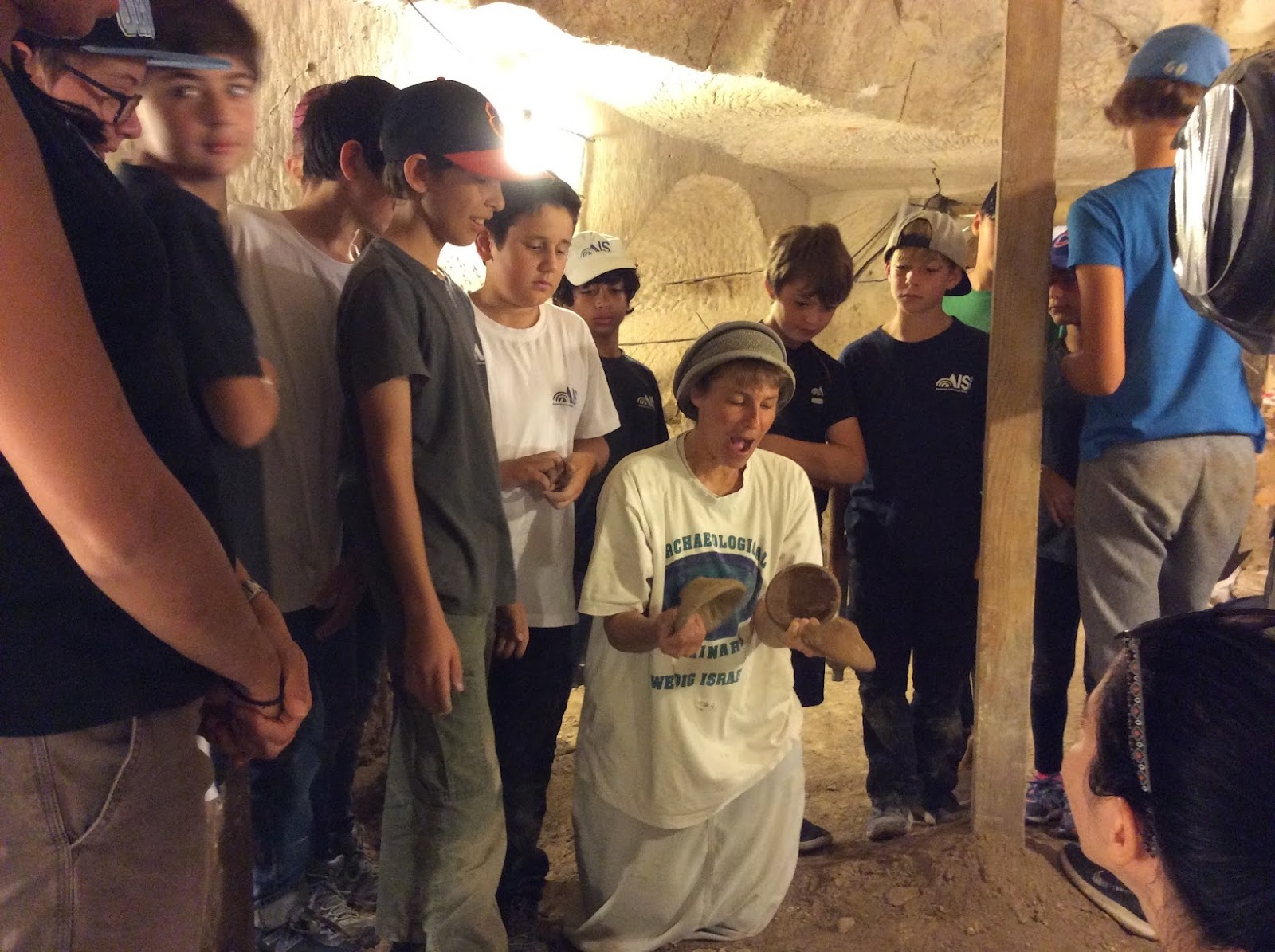
At the end of October, 6th graders visited Beit Guvrin, a National Park in the south of Israel that encompasses Moresha, one of the important towns of ancient Israel known in Biblical times.
Students didn’t mind to make their hands dirty while digging two ancient caves of the past. This time, in the layers of the past, they found unique artifacts that surprised even professional archaeologists!

IMG_1115-bowls.JPG

To understand the significance of hands-on experiences and the importance of excavated remains, students learned about archaeology before the field trip in their Humanities class with Mr. Goury and Ms. Brodsky. They examined how science helped understand human history and got an idea about how to see the culture through the material objects.

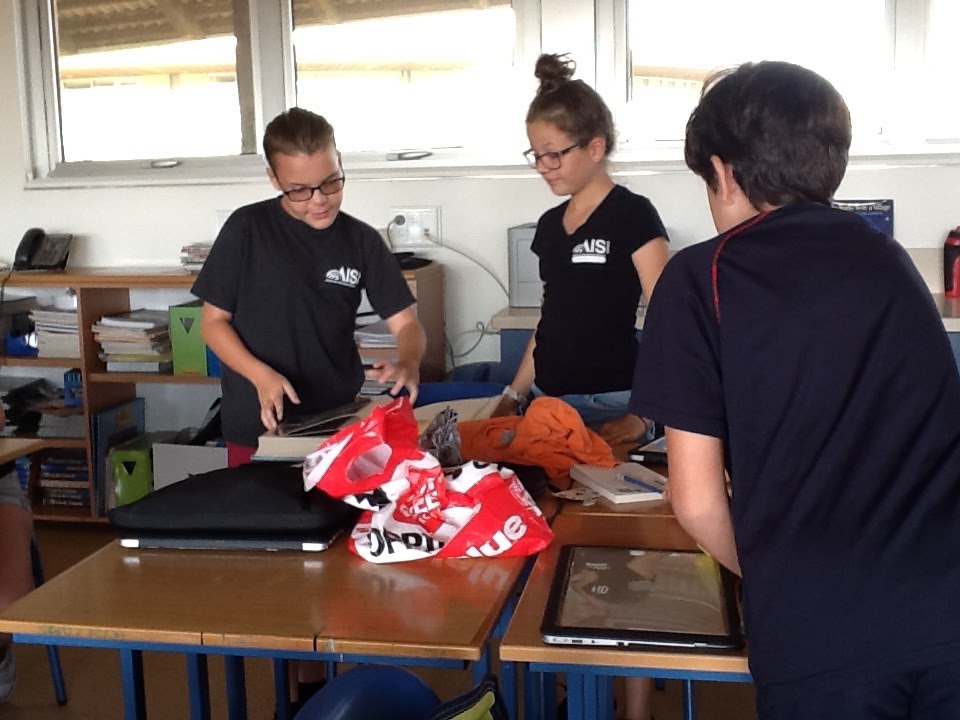
In groups, students composed  “trash bags”. They collected everyday objects that would help archaeologists of the future discern the life of nowadays. Students described the items as if they were the archaeologists, presented them in class, and brainstormed about what could be learned about the 21st century from these artifacts.

The engaging activity made students think of their responsibilities for the future, the importance of taking care and preserving the environment and leaving positive footprints.  Students practiced other essential skills. The work on the mini project encouraged kids to be insightful strategic researchers and effective collaborators. Being an effective communicator, able to listen  and understand, take turns and respect others are crucial in a profile of every individual.


IMG_0004 - trash bag.JPG

Friday, May 27, 2016

Grade 8 Research project

When you see students from Mr. Goury's 8th grade class, ask them how the minus operator changes Google query results.
These students finish the year on a high note practicing research skills while working on Time, Continuity, and Change projects. They use library digital collections and apply search techniques to find materials online to discover facts about their favorite topics.
In which way does the wordless language of emojis evolve? What is the future of travels through space? What makes NBA a global business? Will anime survive if manga becomes less popular?
Active learning instructional strategies prepare 8th graders for future research projects in High School!
 

Thursday, May 5, 2016

The Holocaust Commemoration Day - May 5, 2016

And Let Them Tell Their Story


This year, the  Middle School had a special program on the Holocaust Commemoration Day, May 5th. We were privileged to host ten Holocaust survivors and a group of the Haifa University Weiss-Livnat MA Holocaust Studies students. The program comprised of several parts: the preparation, stories shared by the honored guests followed by a Q&A session, and student post reflection.

Monday, September 28, 2015

Read with a question in mind

startimes.com
This is a reminder and tip for those who work on research projects:

Merge your own thinking with information found in informational books.

It's so easy to get lost in an ocean of sources! What information to pick? Does it support your idea? Is it a fact or opinion? Who is talking about it?Is it biased?
eagleman6788.com


Stop, think, and react on what you have found. Does it answer your research question?

 
Summarize, paraphrase, and quote with proper citations to avoid copyright infringement.

Saturday, November 8, 2014

Web search for Middle School students: choose right keywords for an adequate web site retrieval

http://searchenginewatch.com
Educators don't have a problem to describe  keywords as significant words or phrases that identify the topic of a research. We teach students to put keywords in a search bar of a search engine, catalog or a database. However, Middle School students often complain that they have too many results and it's hard to find adequate articles. Librarians provide young adults with more specific recommendations to help them find relevant information.

Librarians suggest:
  • Before conducting a research, students make a list of questions they try to answer and collect information for. Examine these questions and identify keywords.
  • Relevancy of retrieved web sites depends on what words students have inserted in the search bar and in what order. A keyword headache brings different searches from the results produced by the phrase my head hearts. A keyword dentist retrieves distinct results from those that come as a result for a search for a tooth doctor .
  •  Before they start research, students should think either they need facts or opinion and either they need to provide a variety of points of view. 
  •  Are they collecting statistics, lesson plans, discussions?
  •  Remind the students how search engines work: Web pages are tagged and described in metadata to make them searchable by search engines. If the words chosen by a researcher don't bring helpful web sites, we suggest that students use synonyms and related words .
  • General keywords bring a great number of web sites while focused keywords will limit the number of websites, sometimes more than it is desired. Special terminology  retrieves highly professional articles.Using both types of keywords in the search bar is the best way to find relevant information.
  •   It is recommended to use 5-7 keywords in the search session. Google brings web sites that contain the most of the keywords entered. 
Hopefully, these tips will help your Middle School students find relevant information and grow as web detectives.

Wednesday, October 1, 2014

Research Projects versus Report Papers.


Case Study:


In class, students work on a research project. They use information from multiple sources, take notes and cite materials following the MLA format. They turn their projects to the teacher... and the teacher is disappointed. Research papers look like encyclopedia articles or book reports. 


What is the problem?

Suggestions: 


Before the project is long underway, students examine several research papers. Their attention is drawn to the details that make research papers not a mere review of information found on a topic. A research paper is the result of an intense work and interaction with primary and secondary sources followed by an evaluation of these materials. A research paper is a composition in which students express their personal ideas and points of view and support them by information found in reliable sources.

In addition to presenting a summary of arguments of other authors on the topic (Report), students analyze, examine, discover and revise facts, theories and applications (Research) through a series of steps (Research Process) in order to develop their own ideas and express them in a form of a product. 


You may decide to "apply" knowledge and focus on creating a product. Then, your learning will grow along making and presenting it to the audience.

Keywords:

Primary Sources - are information "collected directly from the real world". They include interviews, surveys, observations, analysis and ethnographic research (Purdue OWL).

Secondary Sources as opposed to primary sources are articles, books or websites that interpret primary sources. These sources are "works of synthesis and interpretation based upon primary sources and the work of other authors" (Teachinghistory.org).

Research – is a diligent and systematic inquiry or investigation into a subject in order to discover or revise facts, theories, applications, etc. Synonyms: investigation, analysis, fact-finding, examination, scrutiny (Webster).

Report - is a review of what others have written about a topic, given a spoken or written account of something that one has observed, heard, done, or investigated, presenting a  summary of arguments of other authors on the topic. Synonyms: describe, communicate, publish, publicize.

Project - is an individual or collaborative enterprise that is carefully planned to achieve a particular aim (Oxford Dictionaries Online)

Research paper reviews the materials written about a topic, draws one’s own conclusions and argues his/her point.

Research Process – is a series of steps, which make up research from the development of an idea to the completed research paper.


Saturday, September 13, 2014

Ten Basic Steps to work on iSearch Project

An amazing learning is happening in Grade 9 classes. Students work on individual projects and go through divergent research experiences.

Students discern that information gives freedom. They face a challenge of meeting with information that "empowers people to do what they want to do", as Steve Ballmer said about information, "It lets people be creative. It lets people be productive. It lets people learn things they didn't think they could learn before, and so in a sense it is all about potential".


TEN Basic Steps to make your iSearch projects successful:

 1. Choose a topic of your interest, the one that you wished to learn but never had time to do so. You are going to work on the project for several weeks, and it's important that you are passionately involved in what you are reading and writing about.

 2. Create Timeline. You need to know when to stop collecting information and start working on an outline, write the paper and create a visual component related to your topic and presenting it in a creative way.

 3. Read broadly on the topic to identify a particular question you would like to write your paper
about. Read encyclopedias such as Britannica and World Book Online to observe what subtopics the topic of your interest holds and choose the direction for your inquiry.


 4. Narrow down your research topic and turn it into a question (create a query). It will help you concentrate on a certain problem.

 5. Read non-fiction books and scholarly articles in order to learn how the question you are asking was attempted by specialists.  Support your hypothesis and ideas.  Use library catalog and library research databases to find detailed reliable information.

 6.  Evaluate web sites when using Internet sources. Authority, objectivity, accuracy and currency of information are factors that identify web sites as credible sources of information. Read more.


 7. Organize collected information and take notes. Use NoodleTools to organize information you have collected. Add sources of information to Bibliography, create note cards and connect them to sources listed in Bibliography. 

 8. Work on an Outline: Use NoodleTools Outline to plan the paper, identify topics and subtopics and add your note cards to support topics and subtopics.

 9. Conclude your research. Compare what you thought you knew and assumed with what you actually discovered. Offer some personal commentary and draw some conclusions. Then apply your conclusions to your own life.

10. Reflect on the research process and describe your growth as a researcher.

Monday, January 28, 2013

Great Discoveries for Statistics

haakonlie.deviantart.com

Research and statistics

High School students were assigned to perform a research on topics covered in Statistics. The goal of this post was to guide students through the research process and help them find appropriate sources.

Research Process

Step 1: Identify a problem

First, identify the topic you want to research on and how it is connected to Statistics.
For example, you could think, "Animals were always a topic of my interest. My wish to work with animals in the future has determined my research project on statistics. How can I connect animals and statistics? How are these two subjects connected?"

Step 2: What do I know?

I know that scientists build plans on preventing endangered animals from extinction, people count species, they use animals for scientific experiments. Scientists work with animals in Zoo parks.

Step 3: What do I want to know?

I want to recognize how statistics is applied to the world of beasts.

Step 4: What resources I can use to learn more on the topic?

  • Library resources
    • books
    • databases
      1. Science Online (Facts on File)
      2. EBSCO (journal articles, scholarly and peer-previewed)
      3. JSTOR (academic articles from professional journals)
  • Websites 
      1. Google Advanced search
      2. Google Scholar and Google Legal

Step 5: How shall I find the resources (Strategies/Skills I will use)?

Identify keywords
Identify reliable sources (Google Scholar, databases, Google Advanced Search, domain site:gov)

Library catalog
Use the library catalog to find resources on your topic.
Open the library catalog, choose Power search and use keywords: animals AND statistics

Life counts : cataloging life on earth    
      by Michael Gleich ... [et al.] ; translated by Steven Rendall ; in collaboration with UNEP, the United National Environment Programme ... [et al.].
Published 2002
If there is a problem, I'll ask Ms. Bee to help me find books in digital format (Questia).

Databases
Use a list of databases on MS/HS Library on Moodle.
Search them with the same keywords,  "animals" and "statistics"

Google Scholar/Google legal

Step 6: Narrowing down the topic

Browsing through the articles' abstracts allowed you to learn more about the use of statistics in the animal world. You've learned that statistics is applied to discover geographic distribution of species and its meaning (JC Willis, GU Yule - Nature, 1922 - blog.sciencenet.cn),  the statistics of natural selection (BFJ Manly - 1985 - cabdirect.org), 
Make a question. For example,
  • How can animal abuse be prevented by statisticians? 
  • What is the minimal number of animals that scientists need for an experiment?
  • Can the number of animals living in a particular area in 10, 20, 30 years be predicted?
Step 7: Research question 
Suppose, you want to answer the first question, How can animal abuse be prevented by statisticians?

Step 8: Keywords for the research question (query)
[animal abuse prevent statistician]
site:gov
Office for the Prevention  of Domestic Violence - http://opdv.ny.gov/whatisdv/dvanimalcrlty.html

Ctrl-F - statistics

Step 9: Analyze search results and what you've learned
WHEN "CRUELTY" IS NECESSARY. 
http://search.ebscohost.com/login.aspx?direct=true&db=ulh&AN=18087172&site=src-live


Protecting more than animals
http://search.ebscohost.com/login.aspx?direct=true&db=hxh&AN=19103753&site=src-live

This article focuses on alternatives for testing chemical toxicity on animals that uses fewer animals. Safety testing of household, agricultural and other chemicals as well as medical products traditionally uses many millions of animals every year in protocols that are often painful. New methods, involving cell and tissue cultures, noninvasive imaging, or plain statistics are greatly reducing the need for, and the suffering involved in, animal testing. The new toxicology is more rigorously based on scientific evidence and can save time and money.

Step 10: Statistics applied to the collected data.
Apply your knowledge to treat the collected data as a statistician.